The IPL auction is a live bidding event in which franchises compete to acquire players within a fixed budget. Teams raise paddles, prices escalate, and in minutes, a cricketer’s fortune changes forever. It’s essentially cricket meets Wall Street, with plenty of drama thrown in.
The BCCI organizes this annual spectacle, allowing ten franchises to build squads before each Indian Premier League season. Understanding how retention, RTM cards, salary caps, and the bidding process work is essential for any cricket fan following the league.
What Is the IPL Auction?
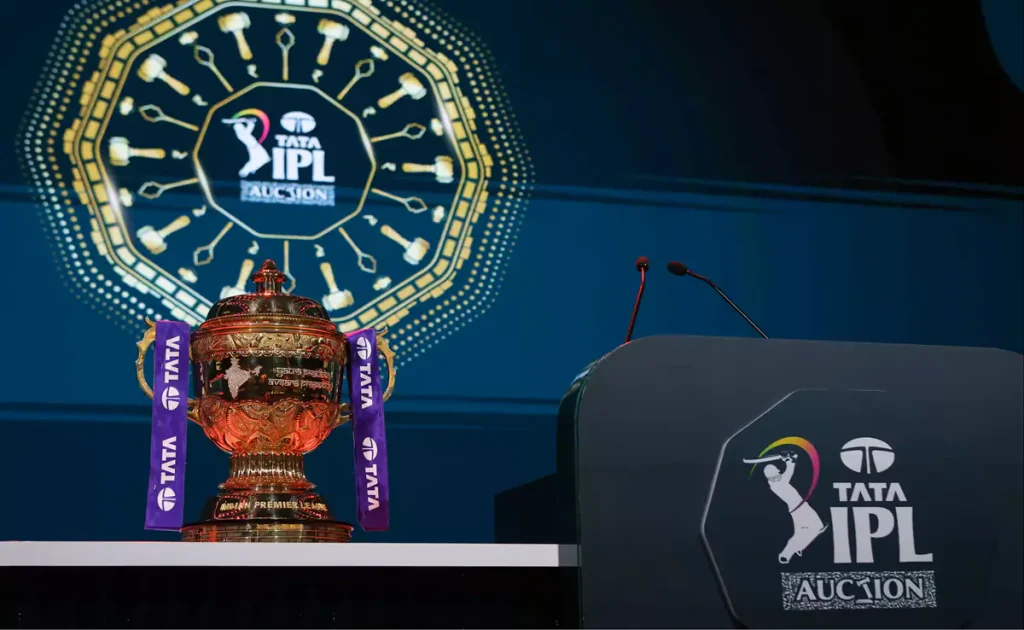
The IPL player auction is an annual event where franchises bid for cricketers to add to their squads. The auction process has taken place every year since the establishment of the Indian Premier League in 2008.
Unlike traditional player drafts used in American sports, the IPL uses an English ascending bid auction format. From an auction-theory perspective, the IPL uses an English ascending-bid auction with physically present bidders.
The franchise that places the highest bid wins the player’s services.
Mega Auction vs Mini Auction
There are two types of IPL auctions, and they serve very different purposes.
Mega auctions happen every three to four years. These auctions provide franchises with opportunities to overhaul their squads more extensively than during regular or mini auctions. Teams can retain only a limited number of players, forcing the majority back into the open market.
The most recent mega auction occurred in November 2024 for the IPL 2025 season. It was held on 24 and 25 November 2024 in Jeddah, Saudi Arabia, with the auction purse for each franchise set at ₹120 crore.
Mini auctions occur in the years between mega auctions. Teams retain most of their squad and only fill gaps. The auction was held on 16 December 2025 in Abu Dhabi, United Arab Emirates.
The IPL 2026 mini-auction had just 77 slots available across all 10 teams.
How Does IPL Player Retention Work?
Before any auction, franchises must decide which players to keep. This is the retention phase.
IPL 2025-27 Retention Rules
The IPL 2025 retention rules allow teams to retain six players, including a maximum of five capped players (Indian or overseas) and up to two uncapped players.
Here’s a breakdown of the retention structure:
| Retention Type | Maximum Allowed |
|---|---|
| Total retentions | 6 players |
| Capped players (Indian/overseas) | 5 players |
| Uncapped Indian players | 2 players |
Retention Salary Slabs
Retained players cost franchises fixed amounts deducted from their auction purse.
If a franchise wants to retain five capped players, the following amounts will be deducted from the purse: INR 18 crore, INR 14 crore, and INR 11 crore.
The fourth and fifth capped retentions cost ₹18 crore and ₹14 crore respectively.
As for the uncapped players, the IPL has stuck with INR 4 crore.
Example calculation:
If a team retains 5 capped players + 1 uncapped player:
- ₹18 + ₹14 + ₹11 + ₹18 + ₹14 + ₹4 = ₹79 crore deducted
That leaves just ₹41 crore for auction purchases from a ₹120 crore purse.
Who Qualifies as an Uncapped Player?
The BCCI introduced an interesting rule that made headlines for MS Dhoni.
A capped Indian player will become uncapped if the player has, in the last five calendar years preceding the year in which the relevant season is held, not played in the starting XI in international cricket.
This allowed Chennai Super Kings to retain Dhoni at just ₹4 crore instead of the higher capped slab.
What Is the Right to Match (RTM) Card?
The RTM card is essentially a franchise’s lifeline to reclaim its former players during the auction.
How RTM Works
The RTM option gives a franchise the chance to buy back a player after the auction by matching the highest bid another franchise made for the player.
Here’s a practical example:
Let’s say KKR releases Venkatesh Iyer. During the auction, the Mumbai Indians win the bidding at ₹10 crore. The auctioneer then asks KKR if they want to exercise RTM.
If KKR says yes, Mumbai gets one final chance to raise its bid. Say they go to ₹12 crore. KKR must now match ₹12 crore to keep Iyer, or he goes to Mumbai.
The 2025 RTM Twist
The BCCI added spice to the RTM rule.
The highest bidder will be given one final opportunity to raise their bid for a player before the team holding the RTM card can exercise their right.
This counter-bid option created several nail-biting moments during the IPL 2025 mega auction.
RTM Card Allocation
Teams don’t get unlimited RTM cards. The number depends on how many players they retain.
Every franchise can retain a maximum of six players either before the auction or during the auction.
If a team retains 6 players, they get zero RTM cards. Retain 5 players, get 1 RTM. Retain 4, get 2 RTMs. And so on.
Teams utilized their Right to Match options strategically, with a total of 8 RTMs used during the auction.
IPL Salary Cap Explained
The salary cap is the maximum amount franchises can spend on player salaries across a season.
IPL 2026 Salary Cap Structure
For IPL 2026, the BCCI set the auction purse at ₹125 crore per team. However, the total salary cap, which includes performance pay and match fees, stands at ₹151 crore per franchise.
The salary cap comprises three components:
| Component | Purpose |
|---|---|
| Auction purse | Player purchases and retentions |
| Incremental performance pay | Bonuses for reaching playoffs/finals |
| Match fees | Per-match payment to players |
Salary Cap Growth Over the Years
The IPL’s financial muscle keeps growing.
Previously in 2024, the total salary cap was INR 110 crores, which will now be INR 146 crores (2025), INR 151 crores (2026), and INR 157 crores (2027).
That’s a 43% increase from 2024 to 2027.
Match Fees: A New Addition
A match fee has been introduced for the first time in the history of IPL. Each playing member (including the Impact Player) will get a match fee of INR 7.5 lakhs per match.
A player featuring in all league matches earns ₹1.05 crore in match fees alone. Not bad for just showing up.
Overseas Player Salary Cap (IPL 2026)
A significant rule change limits overseas player earnings.
The maximum fee an international player can receive will be the lower of two amounts: the highest retention price (Rs 18 crore) or the highest auction price recorded at the previous mega auction.
So when KKR bid ₹25.20 crore for Cameron Green, he only received ₹18 crore. The remaining ₹7.20 crore goes to BCCI’s player development program.
The franchise still loses the full ₹25.20 crore from their purse, though. Brutal, but effective at capping overseas earnings.
The IPL Bidding Process: Step by Step
The auction is where all the planning meets reality. Here’s exactly how it unfolds.
Step 1: Player Registration
Players register for the IPL auction by submitting their names through their national cricket boards, which must approve their participation.
Players choose their own base price, ranging from ₹30 lakh to ₹2 crore. The minimum base price of a player at the IPL 2026 auction was ₹30 lakh, while the maximum base price stood at ₹2 crore.
Step 2: Shortlisting
The BCCI reviews all registrations with input from franchises.
A total of 1,355 players registered for the auction, of which 369 players were shortlisted to feature in the auction, and 77 were sold.
Teams submit wish lists. Players getting the maximum interest make the final pool.
Step 3: Player Categories
The shortlisted players are then grouped into categories such as batters, all-rounders, bowlers, wicketkeepers, capped, uncapped, and overseas.
Top international stars and high-profile Indians become marquee players. They’re auctioned first.
Step 4: Live Bidding
This is where the magic happens.
Live bidding in the IPL auction takes place in a controlled, fast-paced environment led by an auctioneer. Each franchise sits at its designated team table, where representatives use electronic paddles or signal cards to place their bids.
Bid increments work like this:
| Price Range | Increment |
|---|---|
| Up to ₹1 crore | ₹5 lakh |
| ₹1-2 crore | ₹10 lakh |
| ₹2-5 crore | ₹20 lakh |
| Above ₹5 crore | ₹25 lakh |
The auctioneer calls out the player. Interested franchises raise paddles. Bidding continues until only one team remains.
Step 5: RTM Check
If the player’s former franchise holds an RTM card, the auctioneer asks if they want to use it.
If yes, the highest bidder gets one chance to raise the price. Then the former team decides whether to match.
Step 6: Accelerated Auction
After the main round of the auction, an accelerated phase begins, during which the unsold players return for a rapid-fire session.
Teams submit lists of unsold players they’re interested in. These players get a second shot at finding a franchise.
Squad Composition Rules
Building a team isn’t just about buying players. Several regulations govern squad structure.
Squad Size Limits
| Requirement | Number |
|---|---|
| Minimum squad size | 18 players |
| Maximum squad size | 25 players |
| Maximum overseas players in the squad | 8 |
| Maximum overseas players in the playing XI | 4 |
For the IPL 2026 season, each franchise was allotted a total budget of ₹125 crore to build a squad of a minimum of 18 players and a maximum of 25, with up to eight overseas players.
Overseas Player Restrictions
You can buy up to 8 overseas players, but field only 4. This creates interesting strategic decisions.
Do you buy 8 quality overseas stars knowing 4 will warm the bench? Or do you invest in fewer overseas players and strengthen Indian depth?
IPL Auction Records
The auction has produced some eye-watering numbers over the years.
Most Expensive Players in IPL History
| Player | Year | Team | Price |
|---|---|---|---|
| Rishabh Pant | 2025 | Lucknow Super Giants | ₹27 crore |
| Shreyas Iyer | 2025 | Punjab Kings | ₹26.75 crore |
| Cameron Green | 2026 | Kolkata Knight Riders | ₹25.20 crore |
| Mitchell Starc | 2024 | Kolkata Knight Riders | ₹24.75 crore |
| Venkatesh Iyer | 2025 | Kolkata Knight Riders | ₹23.75 crore |
Rishabh Pant was bought for ₹27 crore during the IPL 2025 mega auction in Jeddah. He became the most expensive player in IPL history.
Cameron Green became the most expensive overseas player and the third most expensive player in IPL history when he was bought by Kolkata Knight Riders for ₹25.20 crore.
Most Expensive Uncapped Players
Prashant Veer and Kartik Sharma became the joint-most expensive uncapped players in the history of IPL when they were both bought by Chennai Super Kings for ₹14.20 crore each.
This happened at the IPL 2026 mini auction.
Penalties for Player Withdrawals
The BCCI doesn’t take kindly to players backing out after getting paid.
Any auctioned player withdrawing before the season without a legitimate reason or injury would be banned from the IPL for a period of two years.
England captain Harry Brook learned this the hard way. He withdrew after the 2025 mega auction and was banned from the next two mini auctions.
Impact Player Rule Continues
Despite objections from franchises and concerns from high-profile players such as Rohit Sharma that the Impact Player rule could be detrimental to the development of all-rounders, the IPL has decided to retain it for the next three seasons, up to 2027.
The rule allows teams to substitute a member of the playing XI during a match. This affects the auction strategy, as specialists become more valuable than all-rounders.
IPL 2026 Auction Highlights
The most recent auction delivered plenty of surprises.
Across teams, a total of 173 players have been retained, including 49 overseas players. A combined purse of ₹237.55 crore will be available at the auction across 77 player slots.
Team-wise Purse Before IPL 2026 Auction
| Team | Remaining Purse | Available Slots |
|---|---|---|
| Kolkata Knight Riders | ₹64.30 crore | 13 |
| Chennai Super Kings | ₹43.40 crore | 9 |
| Lucknow Super Giants | ₹22.95 crore | 6 |
| Sunrisers Hyderabad | ₹21.35 crore | 10 |
| Rajasthan Royals | ₹16.05 crore | 9 |
KKR entered with the fattest wallet and made the most aggressive moves.
Notable Buys at IPL 2026 Auction
Matheesha Pathirana isn’t far behind, joining Kolkata Knight Riders for ₹18 crore.
The Sri Lankan pacer’s yorkers clearly impressed the Knight Riders’ think tank.
Mumbai Indians came into the auction with a balance of just ₹2.75 crore but managed to bolster their squad with the experienced wicket-keeper Quinton de Kock at ₹1 crore.
Sometimes the best bargains come when you’re broke.
Auction Strategy: How Franchises Prepare
Behind every bid sit hours of preparation.
Franchises enter the room with real-time projections, analytics sheets, and simulated budget breakdowns. Every bid is backed by hours of scouting and scenario planning that influence final decisions.
Teams typically prepare multiple plans:
- Plan A: Primary targets for each position
- Plan B: Backup options if primary targets get too expensive
- Plan C: Value picks if the purse runs dry
Purse management becomes one of the biggest strategic hurdles in the IPL. Entire think tanks work together to make decisions on the players available in the auction pool.
Overspend on one player, and you might end up with a weak death bowling attack. Hold back too much, and you lose match-winners to rivals.
Replacement Rules
Injuries happen. The IPL has provisions for that.
Till IPL 2024, franchises had to seek a replacement for an injured player before their seventh match of the season. From IPL 2025, teams can seek replacements until the 12th match of the league phase.
This gives franchises more flexibility to assess injuries before making replacements.
Also Read:
The IPL auction combines sporting strategy with financial planning in cricket’s biggest marketplace
From retention decisions and RTM tactics to salary cap management and live bidding wars, every franchise faces high-stakes choices that shape its season.
Understanding these mechanics helps fans appreciate why certain players command record prices while others go unsold. With the total salary cap reaching ₹157 crore by 2027, the numbers will only get bigger. The drama? That’s guaranteed to stay the same.