At the 1975 Men’s Field Hockey World Cup, India and Pakistan played a final so intense it is still talked about today, while the 1980 Winter Olympics saw the United States stun the Soviet Union in a game that changed ice hockey forever.
Two sports built around sticks, goals, and teams, yet separated by almost everything else. One is played on grass under open skies, the other on ice inside an arena. Both demand skill, stamina, and sharp decision-making from every player.
This article breaks down every major difference between field hockey and ice hockey, from the surface to the rules.
Quick Overview: Field Hockey vs Ice Hockey
Both sports carry the word hockey in their name, but the experience of playing or watching them is completely different.
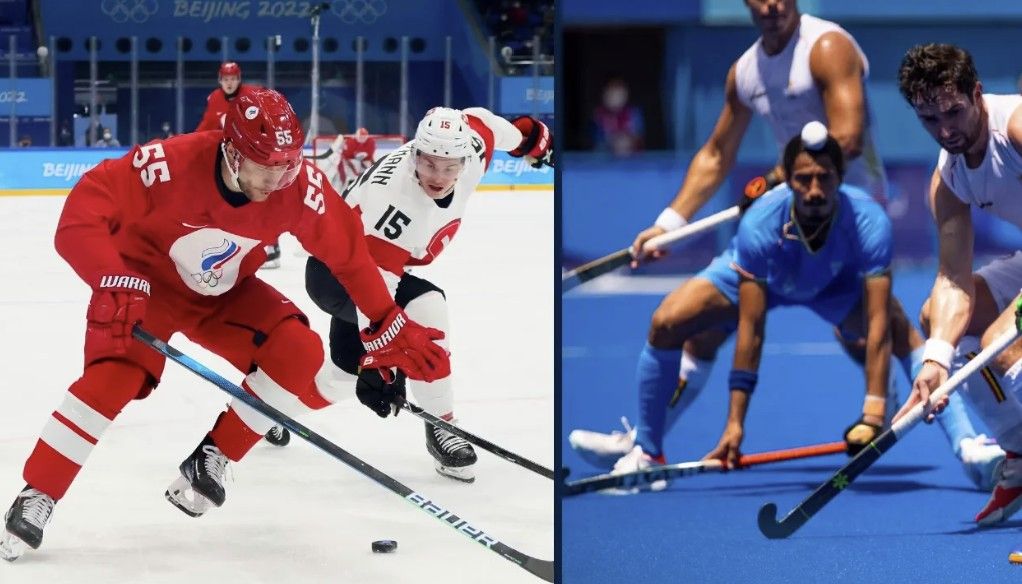
Here is a clean side-by-side look at the core facts before we go deeper into each area.
| Feature | Field Hockey | Ice Hockey |
|---|---|---|
| Surface | Grass or artificial turf | Indoor ice rink |
| Object used | Hard PVC ball | Vulcanized rubber puck |
| Players per side | 11 (including goalkeeper) | 6 (including goaltender) |
| Physical contact | Non-contact, no body checking | Full contact, body checking allowed |
| Game duration | 60 min – four 15-min quarters | 60 min – three 20-min periods |
| Scoring zone | Only from inside the D circle | From anywhere on the ice |
| Stick type | Short, J-shaped, one usable side | Long, two usable sides |
| Footwear | Cleats or turf shoes | Ice skates |
These eight differences alone tell you why the two sports feel so different to play, even though the basic goal of scoring into a net remains the same in both.
Where Is Each Sport Played
The playing surface is the most visible difference between the two sports, and it shapes everything else about how each game is played, from the footwear athletes wear to the tactics coaches use.
Field hockey is played on natural grass or water-based artificial turf. The pitch is 100 yards long and 60 yards wide, which gives players a large area to cover and demands strong aerobic fitness throughout the full 60 minutes.
| Feature | Field Hockey | Ice Hockey |
|---|---|---|
| Surface type | Natural grass or artificial turf | Indoor ice rink |
| Dimensions | 100 yards x 60 yards | 200 feet x 85 feet |
| Setting | Outdoors | Indoors |
| Player speed | Running pace | 20–30 mph on skates |
Ice hockey is played on an indoor ice rink that measures 200 feet by 85 feet. Players skate at speeds between 20 and 30 miles per hour, making it one of the fastest team sports in the world.
How Many Players Are on Each Side
The number of players on the field or ice directly affects how much space each player covers and how quickly the game moves. The two sports have very different squad sizes on the playing surface at any one time.
Field hockey fields 11 players per side, including the goalkeeper, with positions spread across forwards, midfielders, and defenders covering the entire 100-yard pitch. Ice hockey fields just 6 players per side, made up of three forwards, two defenders, and one goaltender
| Feature | Field Hockey | Ice Hockey |
|---|---|---|
| Players per side | 11 | 6 |
| Goalkeeper/Goaltender | 1 | 1 |
| Outfield players | 10 | 5 |
| Player rotation | Per quarter | Every ~45 seconds |
Because the pace is so high in ice hockey, players rotate every 45 seconds on average to stay fresh, while field hockey players stay on for full quarters with short breaks between them.
The Sticks They Use
The stick is the most important piece of equipment in both sports, but the design of each stick is built for a completely different style of play. Using the wrong stick in the wrong sport would make the game almost impossible.
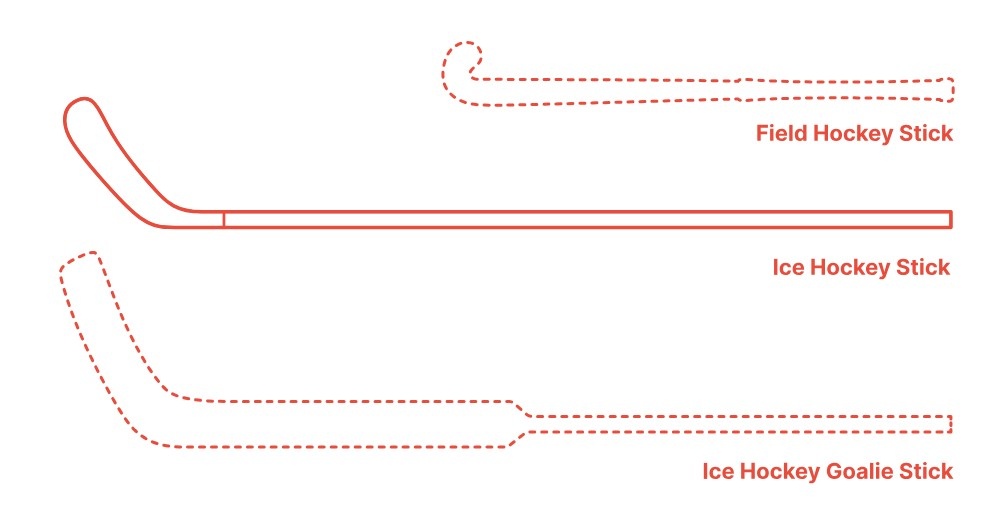
| Feature | Field Hockey Stick | Ice Hockey Stick |
|---|---|---|
| Length | Short | Long |
| Shape | J-shaped curved head | Straight shaft, curved blade |
| Usable sides | One (flat face only) | Both sides |
| Material | Wood or composite | Composite or wood |
The design of each stick is a direct response to the surface it is used on and the object it controls, which is why the two look and feel so completely different from each other.
The Equipment and Protection
The protective gear in each sport tells you a lot about how physical the game is. The more contact a sport involves, the more protection athletes need to stay safe throughout a full match.
Field hockey players wear cleats or turf shoes, light shin guards, and a mouthguard. Goalkeepers wear full padding, including a helmet, chest guard, and leg pads. Ice hockey players wear a full set of protective gear that includes a helmet, shoulder pads, elbow pads, heavily padded gloves, padded shorts, shin guards, and ice skates with steel blades.
| Equipment | Field Hockey | Ice Hockey |
|---|---|---|
| Footwear | Cleats or turf shoes | Ice skates with steel blades |
| Head protection | Goalkeepers only | All players (helmet) |
| Body padding | Minimal for outfield players | Full shoulder and elbow pads |
| Gloves | Not worn | Heavily padded gloves |
| Shin guards | Light | Heavy |
Ice hockey pucks can travel at over 100 miles per hour, which is exactly why every player from the goaltender to the forwards wears serious head-to-toe protection at all times.
How Long Each Game Lasts
Both sports have a total playing time of 60 minutes, but the structure of that time is different in each game. That structure affects how teams manage energy and how coaches plan their approach across the match.
| Sport | Total Time | How It Is Divided |
|---|---|---|
| Field Hockey | 60 minutes | Four quarters of 15 minutes each |
| Ice Hockey | 60 minutes | Three periods of 20 minutes each |
Field hockey splits the game into four 15-minute quarters, giving teams regular breaks to reset and adjust their tactics. Ice hockey plays three 20-minute periods with two intermissions, during which the ice surface is cleaned and resurfaced. The longer periods in ice hockey mean teams rely heavily on rotating player lines every 45 seconds to keep energy levels consistent and maintain the pace throughout each period.
Rules and Physical Contact
The rules in each sport reflect the playing surface and physical demands of the game. One of the clearest differences between field hockey and ice hockey is how much physical contact is allowed between players during a match.
Field hockey is a non-contact sport. Players cannot use their bodies to push, block, or charge into an opponent, and the ball can only be played with the flat side of the stick. Fouls are given for obstruction, dangerous stick use, and any deliberate contact with the ball using the body.
| Rule Area | Field Hockey | Ice Hockey |
|---|---|---|
| Contact allowed | No | Yes (body checking) |
| Stick usage | Flat side only | Both sides of the blade |
| Ball/puck scoring zone | Inside the D circle only | Anywhere on the ice |
| Common fouls | Obstruction, dangerous stick | Tripping, slashing, high-sticking |
Ice hockey is a full-contact sport where body checking is legal. Players can use their hip or shoulder to hit an opponent who has the puck, and this physical element is a central and accepted part of the game at every level of competition worldwide.
Penalties and Fouls
Both sports have well-defined systems for dealing with players who break the rules. The structure of penalties reflects how different the pace and physical nature of each game truly are at every level.
In field hockey, fouls result in a free hit, a penalty corner, or a penalty stroke, depending on where the offence happened and how serious it was. Players can receive green, yellow, or red cards for misconduct.
| Feature | Field Hockey | Ice Hockey |
|---|---|---|
| Penalty type | Free hit, penalty corner, penalty stroke | Penalty box (2 or 5 minutes) |
| Card system | Green, yellow, red cards | No card system |
| Team impact | Opposition gets set piece | Team plays short-handed |
| Advantage given | Dead-ball restart | Power play opportunity |
In ice hockey, apenalizedd player goes to the penalty box for two minutes for a minor penalty or five minutes for a major penalty. Their team plays short-handed during that time, giving the opposing side a power play advantage that can completely change the momentum and direction of a game.
The Athletic Demands of Each Sport
Field hockey demands strong aerobic endurance, precise stick control at full running speed, and the ability to read the game tactically across a large area for 60 full minutes. Ice hockey demands explosive skating power, technical skill at very high speed, and the physical toughness to compete in a full-contact environment.
| Athletic Demand | Field Hockey | Ice Hockey |
|---|---|---|
| Primary fitness type | Aerobic endurance | Explosive power and speed |
| Key skill | Stick control and tactical reading | Skating and puck handling |
| Physical contact | Non-contact | Full contact |
| Game reading | Across a wide pitch over 60 minutes | Fast decisions in short shifts |
Ice hockey players must master five core skills: skating, stopping, stick handling, passing, and shooting, all performed on bladed ice skates under constant pressure from fast-moving opponents around them.
Where Each Sport Is Most Popular
Field hockey and ice hockey have grown in completely different parts of the world. The climate of a country, its sporting history, and the facilities available have all shaped where each sport has built its biggest following over time.
Field hockey is most popular in India, Pakistan, Australia, the Netherlands, Germany, and England.
| Feature | Field Hockey | Ice Hockey |
|---|---|---|
| Top nations | India, Pakistan, Australia, Netherlands, Germany, England | Canada, USA, Russia, Sweden, Finland, Czech Republic |
| Olympic category | Summer Olympics | Winter Olympics |
| Governing body | FIH (International Hockey Federation) | IIHF (International Ice Hockey Federation) |
| Climate association | Warm and temperate countries | Cold-climate countries |
It is a key sport at the Summer Olympics with a long international history built over more than a century. Ice hockey dominates in colder countries, including Canada, the United States, Russia, Sweden, Finland, and the Czech Republic.
The NHL averaged 17,400 fans per game in the 2018-19 season, showing just how deeply ice hockey connects with fans across North America and beyond.
Related Reads:
Conclusion: Grass, Ice, One Game, Infinite Passion
Field hockey and ice hockey share a name and a basic concept but almost nothing else. One rewards precise technique and tactical intelligence across a wide-open pitch. The other rewards explosive power, skating skill, and physical toughness on a faster and more physical stage.
Both have produced legendary athletes and unforgettable moments at the highest level. Whichever side you prefer, both sports represent the same deep love of competition played out in two completely different ways.