Before the English Premier League was born. Before the FIFA World Cup existed. Before most of the world had even heard of association football, a British foreign secretary recovering from illness in the Himalayan hills of Shimla decided to organize a football tournament.
That was 1888.
That tournament is still running today.
The Durand Cup isn’t just a trophy. It’s a living, breathing time capsule of Indian football, one that has outlasted empires, survived two World Wars, a partition, a pandemic, and the rise and fall of countless clubs. If you want to understand Indian football, you start here.
What Is the Durand Cup? The Tournament That Predates Everything
The Durand Cup is the oldest existing club football tournament in Asia and the fifth oldest national football competition in the world. It was founded by Sir Henry Mortimer Durand, who served as the Foreign Secretary of British India from 1884 to 1894.
Sir Henry was recuperating from illness in Shimla when, having become conscious of the value of sport as a means to maintain health, he decided to present a prize to encourage sporting competition in India.
What started as a military exercise for British regiments grew into Asia’s premier football spectacle, a tournament that now features ISL giants, army teams, and clubs from every corner of India.
Key facts at a glance:
- Founded: 1888 in Shimla (Dagshai), Himachal Pradesh
- Status: Asia’s oldest club football tournament; world’s third oldest
- Organizer: Durand Football Tournament Society (DFTS) + All India Football Federation (AIFF)
- Format: Round-robin group stage (24 teams) followed by knockout rounds
- Current home: Kolkata and multiple eastern Indian cities
- Prize pool (2025): ₹3 crore — a record high
The Three Trophies: Why Winning the Durand Cup Is Uniquely Special
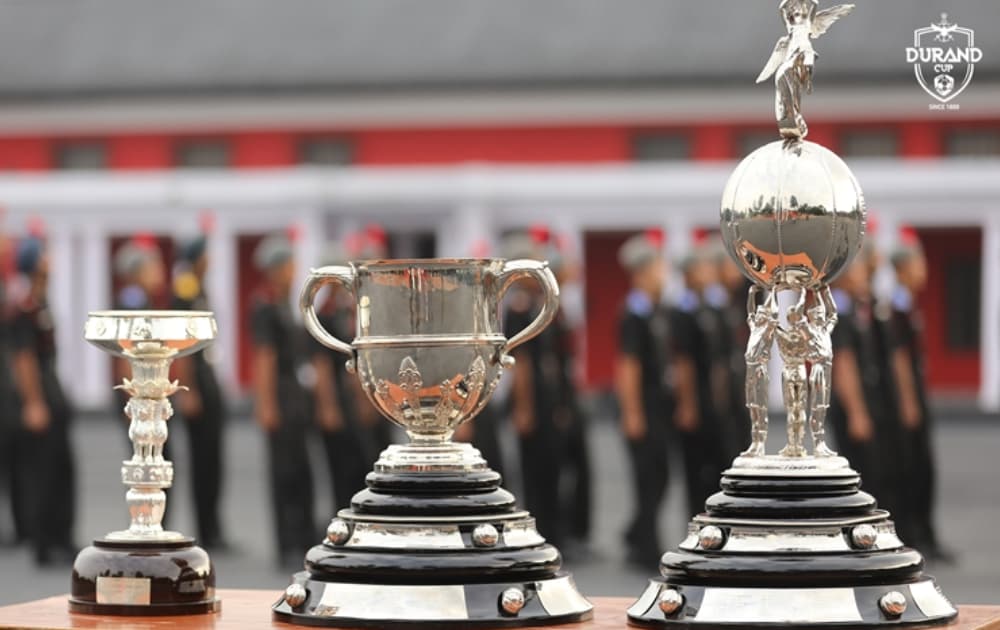
No other football tournament in the world gives out three trophies to one winner. The Durand Cup does.
Each trophy tells a different chapter of India’s story:
1. The Durand Cup (“The Masterpiece”) The original trophy from 1888. The Durand Football Tournament Society declared this Durand Cup a rolling trophy in 1965, meaning the winning club holds it for one year and returns it before the next edition.
2. The Shimla Trophy (“The Artistry”) Donated by the citizens of Shimla in 1904, this rolling trophy reflects the strong local support and enthusiasm for the tournament. It has been awarded since 1904, nearly as old as the tournament itself.
3. The President’s Cup (“The Pride”) Donated by India’s first President, Dr. Rajendra Prasad, it represents the post-independence Indian identity of the tournament. Unlike the other two, the President’s Cup is a permanent keep, the winning team never has to give it back.
Durand Cup Winners List: All Champions Since 1888
Era 1: The British Regimental Years (1888–1939)
This is the tournament’s colonial chapter, all winners were British or Indian military regiments. The Highland Light Infantry were the early dynasty, claiming five titles in this period. The Black Watch were another dominant force.
| Year | Winner | Runner-Up |
|---|---|---|
| 1888 | Royal Scots Fusiliers | Highland Light Infantry |
| 1889 | Highland Light Infantry | Shimla Rifles |
| 1890 | Highland Light Infantry | Royal Irish Fusiliers |
| 1891 | King’s Own Scottish Borderers | East Lancashire Regiment |
| 1892 | King’s Own Scottish Borderers | Argyll and Sutherland Highlanders |
| 1893 | Highland Light Infantry | Argyll and Sutherland Highlanders |
| 1894 | Highland Light Infantry | Royal Scots Fusiliers |
| 1895 | Highland Light Infantry | Somerset Light Infantry |
| 1896 | Somerset Light Infantry | Black Watch |
| 1897 | Black Watch | Shimla Rifles |
| 1898 | Black Watch | North Staffordshire Regiment |
| 1899 | Black Watch | Yorkshire Regiment |
| 1900 | South Wales Borderers | East Lancashire Regiment |
| 1901 | South Wales Borderers | South Staffordshire Regiment |
| 1902 | Hampshire Regiment | East Lancashire Regiment |
| 1903 | Royal Irish Rifles | Queen’s Regiment |
| 1904 | North Staffordshire Regiment | Black Watch |
| 1905 | Royal Dragoons | Dorsetshire Regiment |
| 1906 | Cameronians (Scottish Rifles) | Bedfordshire Regiment |
| 1907 | Cameronians (Scottish Rifles) | Royal Welch Fusiliers |
| 1908 | Lancashire Fusiliers | Royal Irish Rifles |
| 1909 | Lancashire Fusiliers | King’s Regiment |
| 1910 | Royal Scots | King’s Royal Rifle Corps |
| 1911 | Black Watch | Lancashire Fusiliers |
| 1912 | Royal Scots | Lancashire Fusiliers |
| 1913 | Lancashire Fusiliers | King’s Royal Rifle Corps |
| 1920 | Black Watch | Cameronians (Scottish Rifles) |
| 1921 | Worcestershire Regiment | Royal Fusiliers |
| 1922 | Lancashire Fusiliers | Royal Field Artillery |
| 1923 | Cheshire Regiment | Essex Regiment |
| 1924 | Worcestershire Regiment | Essex Regiment |
| 1925 | Sherwood Foresters | Worcestershire Regiment |
| 1926 | Durham Light Infantry | Sherwood Foresters |
| 1927 | York and Lancaster Regiment | Eastern Railway SC |
| 1928 | Sherwood Foresters | York and Lancaster Regiment |
| 1929 | York and Lancaster Regiment | East Yorkshire Regiment |
| 1930 | York and Lancaster Regiment | Royal Leicestershire Regiment |
| 1931 | Devonshire Regiment | Border Regiment |
| 1932 | King’s Shropshire Light Infantry | Devonshire Regiment |
| 1933 | King’s Shropshire Light Infantry | Royal Leicestershire Regiment |
| 1934 | Royal Corps of Signals | Argyll and Sutherland Highlanders |
| 1935 | Border Regiment | Royal Norfolk Regiment |
| 1936 | Argyll and Sutherland Highlanders | Green Howards |
| 1937 | Border Regiment | Royal Scots |
| 1938 | South Wales Borderers | Border Regiment |
Note: The tournament was suspended from 1914–1919 due to World War I and again in 1939 due to the outbreak of World War II.
The Turning Point: 1940 — India’s Own Claim the Cup
A milestone moment arrived in 1940 when Mohammedan Sporting Club, a team from Kolkata, defeated the Royal Warwickshire Regiment 2–1 to become the first Indian team to win the Durand Cup.
This was not just a football result. It was a cultural statement, an Indian civilian club beating a British military regiment, in a tournament designed by British colonial rulers. The Durand Cup had changed forever.
| Year | Winner | Runner-Up |
|---|---|---|
| 1940 | Mohammedan Sporting Club | Royal Warwickshire Regiment |
Era 2: Post-Independence Indian Football (1950–Present)
After the chaos of Partition, the tournament lay dormant. The Durand Cup was accidentally discovered in the office of then Commander-in-Chief Sir Claude Auchinleck after 1947. Defence Secretary H.M. Patel stepped in to rescue the trophy and the tournament, setting up the Durand Football Tournament Society to keep it alive.
The tournament resumed in 1950, and Indian football’s greatest clubs stepped into the spotlight.
| Year | Winner | Runner-Up |
|---|---|---|
| 1950 | Hyderabad City Police | Mohun Bagan |
| 1951 | East Bengal | Rajasthan Armed Constabulary |
| 1952 | East Bengal | Hyderabad City Police |
| 1953 | Mohun Bagan | National Defence Academy |
| 1954 | Hyderabad City Police | Hindustan Aircraft Limited |
| 1955 | Madras Regimental Centre | Indian Air Force |
| 1956 | East Bengal | Hyderabad City Police |
| 1957 | Hyderabad City Police | East Bengal |
| 1958 | Madras Regimental Centre | Gorkha Brigade |
| 1959 | Mohun Bagan | Mohammedan SC |
| 1960 | Mohun Bagan & East Bengal | Joint (draw after extra time) |
| 1961 | Andhra Pradesh Police | Mohun Bagan |
| 1963 | Mohun Bagan | Andhra Pradesh Police |
| 1964 | Mohun Bagan | East Bengal |
| 1965 | Mohun Bagan | Punjab Police |
| 1966 | Gorkha Brigade | Sikh Regimental Centre |
| 1967 | East Bengal | Bengal Nagpur Railway |
| 1968 | Border Security Force | East Bengal |
| 1969 | Gorkha Brigade | Border Security Force |
| 1970 | East Bengal | Mohun Bagan |
| 1971 | Border Security Force | Leaders Club |
| 1972 | East Bengal | Mohun Bagan |
| 1973 | Border Security Force | Rajasthan Armed Constabulary |
| 1974 | Mohun Bagan | JCT |
| 1975 | Border Security Force | JCT |
| 1976 | Border Security Force & JCT | Joint (draw after extra time) |
| 1977 | Mohun Bagan | JCT |
| 1978 | East Bengal | Mohun Bagan |
| 1979 | Mohun Bagan | Punjab Police |
| 1980 | Mohun Bagan | Mohammedan SC |
| 1981 | Border Security Force | JCT |
| 1982 | Mohun Bagan & East Bengal | Joint (draw after extra time) |
| 1983 | JCT | Mohun Bagan |
| 1984 | Mohun Bagan | East Bengal |
| 1985 | Mohun Bagan | JCT |
| 1986 | Mohun Bagan | East Bengal |
| 1987 | JCT | Mohun Bagan |
| 1988 | Border Security Force | East Bengal |
| 1989 | East Bengal | Mohun Bagan |
| 1990 | East Bengal | Mahindra & Mahindra |
| 1991 | East Bengal | Border Security Force |
| 1992 | JCT | Mohammedan SC |
| 1993 | East Bengal | Punjab State Electricity Board |
| 1994 | Mohun Bagan | East Bengal |
| 1995 | East Bengal | Tata Football Academy |
| 1996 | JCT | Al-Naft |
| 1997 | Kochin | Mohun Bagan |
| 1998 | Mahindra United | East Bengal |
| 1999 | Salgaocar | East Bengal |
| 2000 | Mohun Bagan | Mahindra United |
| 2001 | Mahindra United | Churchill Brothers |
| 2002 | East Bengal | Army XI |
| 2003 | Salgaocar | East Bengal |
| 2004 | East Bengal | Mohun Bagan |
| 2005 | Army XI | Sporting Goa |
| 2006 | Dempo | JCT |
| 2007 | Churchill Brothers | Mahindra United |
| 2008 | Mahindra United | Churchill Brothers |
| 2009 | Churchill Brothers | Mohun Bagan |
| 2010 | United SC (Prayag United) | JCT |
| 2011 | Churchill Brothers | Prayag United |
| 2012 | Air India | Dodsal FC |
| 2013 | Mohammedan SC | ONGC |
| 2014 | Salgaocar FC | Pune FC |
| 2016 | Army Green | NEROCA FC |
| 2019 | Gokulam Kerala | Mohun Bagan |
| 2021 | FC Goa | Mohammedan SC |
| 2022 | Bengaluru FC | Mumbai City FC |
| 2023 | Mohun Bagan Super Giant | East Bengal |
| 2024 | NorthEast United FC | Mohun Bagan Super Giant |
| 2025 | NorthEast United FC | Diamond Harbour FC |
Note: No editions were held in 1914–1919 (WWI), 1939–1949 (WWII + Partition), 1962 (Sino-Indian War), 2015, 2017–2018, and 2020 (COVID-19).
Durand Cup Most Wins: The Champions Table
All-Time Top Winners
| Rank | Club | Titles |
|---|---|---|
| 1 | Mohun Bagan / Mohun Bagan Super Giant | 17 |
| 2 | East Bengal / Emami East Bengal | 16 |
| 3 | Border Security Force (BSF) | 8 |
| 4 | JCT FC | 5 |
| 5 | Black Watch (British regiment) | 5 |
| 5 | Highland Light Infantry (British regiment) | 5 |
| 6 | Lancashire Fusiliers (British regiment) | 4 |
| 6 | Mahindra United | 4 |
| 7 | Churchill Brothers | 3 |
| 7 | Salgaocar FC | 3 |
Mohun Bagan and East Bengal also hold the record for the most runner-up finishes in the Durand Cup, with 14 and 11 appearances in the final respectively.
Salgaocar are the only team to have never lost a final in the competition, with wins in 1999, 2003, and 2014, a perfect record in three appearances.
The Kolkata Derby: The Durand Cup’s Greatest Rivalry
You cannot tell the story of the Durand Cup without talking about East Bengal vs. Mohun Bagan. The two Kolkata giants have met in Durand Cup finals more times than any other combination of clubs, and their battles have defined entire eras of the tournament.
Key Kolkata Derby moments in Durand Cup history:
- 1960 and 1982: The final ended in a draw even after extra time — the trophy was shared between the two clubs, a remarkable resolution that reflects how evenly matched they have been.
- 1963–1965: Mohun Bagan won three straight Durand Cups, one of the dominant streaks in the tournament’s history.
- 1984–1986: Mohun Bagan did it again — three consecutive titles, cementing their status as the tournament’s greatest club.
- 1989–1991: East Bengal answered with three straight titles of their own.
- 2023: The derby came to a final again, with Mohun Bagan Super Giant defeating their eternal rivals.
The Mariners are the only club to win three consecutive editions of the Durand Cup twice — from 1963 to 1965 and again from 1984 to 1986. East Bengal also recorded a hat-trick of triumphs from 1989 to 1991.
Records and Milestones Every Fan Should Know
- Most titles: Mohun Bagan Super Giant — 17
- Most finals played: Mohun Bagan — 31
- Most appearances: Mohun Bagan — 29 editions (1950–2022)
- Only unbeaten finalist: Salgaocar FC — Won all 3 finals they appeared in (1999, 2003, 2014)
- First Indian team to win: Mohammedan Sporting Club (1940)
- First post-independence winner: Hyderabad City Police (1950)
- Only army team to win in the modern era: Army Green (2016)
- Back-to-back champions (recent): NorthEast United FC (2024 and 2025)
- Record prize pool: ₹3 crore in the 2025 edition
- Biggest final attendance: 43,000 spectators at the 2019 final in Kolkata
The Near-Death and Rebirth of the Durand Cup
The tournament has been on the brink of extinction more than once:
The Durand Cup had only been scrapped owing to wars and events of massive political implications, 1914–1919 for World War I, 1939 for World War II, 1941–1949 due to World War II and India’s partition, and 1962 due to the Indo-China War.
Then, in the modern era, the tournament almost died again, not from war, but from irrelevance. With the glitz and glamour of the ISL and the Super Cup emerging to take over the Durand Cup’s role as India’s top-tier Cup competition, the Durand Cup slowly fell from grace. From 2015 to 2018, only a low-key 2016 edition was held.
The revival came in 2019 when the Durand Cup came under the aegis of the Eastern Command and shifted to the football heartland of the East, with Kolkata, the Mecca of Indian football, as its home base.
Since then the transformation has been dramatic. The tournament has grown from a single-city event into a multi-city, multi-state sporting spectacle. For the first time ever, the Durand Cup is being played across five states, West Bengal, Jharkhand, Assam, Meghalaya, and Manipur.
From 2022, the AIFF mandated participation for all Indian Super League clubs, making the Durand Cup the official curtain raiser for every Indian football season.
Why the Durand Cup Still Matters in 2026
In an era dominated by franchise football and television-driven leagues, the Durand Cup offers something increasingly rare: genuine history.
- It is the tournament where young ISL players get their first taste of competitive football before the season begins.
- It is the only major Indian football tournament organized and run by the Armed Forces, keeping alive a unique civil-military tradition.
- It gives smaller clubs — state police teams, regional sides, northeastern outfits like NorthEast United — a genuine path to glory on a national stage.
- It has produced back-to-back champions in NorthEast United FC (2024, 2025), signaling a shift in Indian football’s power centers away from Kolkata alone.
The Durand Cup was born before India was India. And it is still going, stronger than it has been in decades.
Quick Reference: Durand Cup by the Numbers
| Stat | Figure |
|---|---|
| Year founded | 1888 |
| Total editions (as of 2025) | 134 |
| Total unique winners | 44+ |
| Most titles (club) | 17 — Mohun Bagan Super Giant |
| Most titles (pre-independence) | 5 — Highland Light Infantry |
| Record final attendance | 43,000 (2019, Kolkata) |
| Prize pool (2025) | ₹3 crore |
| Current home city | Kolkata + eastern India |
| Trophies awarded per winner | 3 (Durand Cup, Shimla Trophy, President’s Cup) |
| Defending champion (2025) | NorthEast United FC |
The Durand Cup is not just the oldest football tournament in Asia. It is a mirror of India itself — colonial, conflicted, resilient, and undeniably passionate about the beautiful game.