
The IPL playoff format is a four-match knockout system used to decide the Indian Premier League champion after the league stage. The top four teams in the IPL points table qualify for the playoffs, with Qualifier 1, Eliminator, Qualifier 2, and the Final determining the IPL 2026 winner.
Teams finishing in the top two positions get two chances to reach the final, while the third and fourth-placed teams must win every knockout match. The IPL playoff system rewards consistency during the league stage and creates high-pressure clashes on the road to the title.
How the IPL Playoff System Works
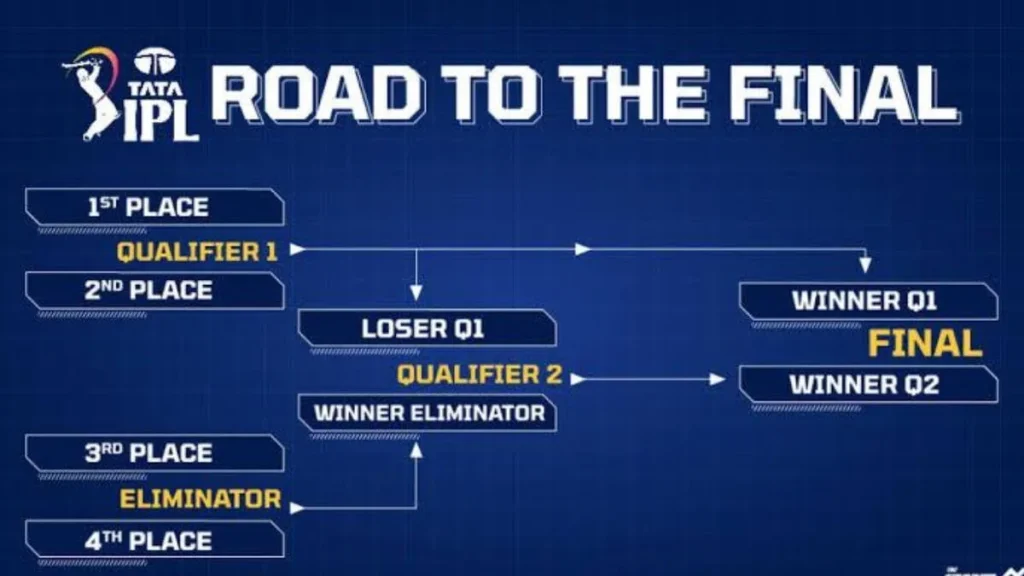
After 70 league stage matches, the top four teams on the IPL points table qualify for the playoffs.
The playoffs consist of four knockout matches: Qualifier 1, Eliminator, Qualifier 2, and the IPL Final.
Each match is played on a different day, giving teams adequate rest between high-pressure games.
Think of it as a ladder. Finish higher on the table, and you get a safety net. Finish lower, and every match becomes a tightrope walk.
IPL 2026 Playoff Schedule
| Match | Date | Teams Involved |
|---|---|---|
| Qualifier 1 | May 26, 2026 | 1st vs 2nd |
| Eliminator | May 27, 2026 | 3rd vs 4th |
| Qualifier 2 | May 29, 2026 | Loser of Q1 vs Winner of Eliminator |
| Final | May 31, 2026 | Winner of Q1 vs Winner of Q2 |
What is Qualifier 1 in IPL?
Qualifier 1 is the first playoff match featuring the teams that finish 1st and 2nd on the league table.
The winner of this match directly qualifies for the IPL Final. No pressure, no second chances needed.
The losing team is not eliminated, though. They get another shot in Qualifier 2 against the Eliminator winner.
This is why finishing in the top two is such a massive advantage. You essentially get two bites at the championship apple.
Why Finishing Top 2 Matters So Much
Teams in positions 1 and 2 have a clear path advantage. Win Qualifier 1, and you skip straight to the final with extra rest days.
Lose Qualifier 1? No worries. You still have Qualifier 2 to fight your way back.
Teams finishing 3rd or 4th do not get this luxury. One bad game, and their IPL dream ends.
What is the Eliminator in IPL?
The Eliminator is a knockout match between the 3rd- and 4th-placed teams from the points table.
The name says it all. Lose this game, and you are eliminated from the tournament. No second chances here.
The winner advances to Qualifier 2 to face the loser of Qualifier 1.
Historically, winning the Eliminator has been tough. Since the format started in 2011, Eliminator winners have reached the final only 3 times and won the trophy just once.
Why the Eliminator is the Most Pressure-Packed IPL Match
Unlike Qualifier 1, where both teams survive regardless of the result, the Eliminator offers no such comfort.
Players feel the weight of every dot ball, every dropped catch, and every poor shot selection.
Even if you win, you still need to win two more games to lift the trophy. That is a grueling path compared to teams that finished higher.
What is Qualifier 2 in IPL?
Qualifier 2 determines the second finalist. It features the loser of Qualifier 1 against the winner of the Eliminator.
For the Qualifier 1 loser, this is their redemption match. For the Eliminator winner, this is another must-win game.
The winner earns the right to face the Qualifier 1 winner in the IPL Final.
Think of it as a second chance versus survival mode. The team from Qualifier 1 usually carries more momentum and confidence.
The IPL Final: Where Champions Are Crowned
The IPL Final is the culmination of two months of cricket action. It pits the Qualifier 1 winner against the Qualifier 2 winner.
The IPL 2026 Final is scheduled for May 31, 2026, at the M. Chinnaswamy Stadium in Bengaluru.
Winning the final is the ultimate goal. Everything else is just a stepping stone.
How the IPL Points Table Determines Playoff Qualification
Each team plays 14 league-stage matches in IPL 2026, for a total of 70 games before the playoffs.
Teams earn 2 points for a win, 1 point for a tie or no result, and 0 points for a loss.
The top four teams based on total points qualify for the playoffs.
What is Net Run Rate (NRR) and Why Does It Matter?
When teams are tied on points, Net Run Rate (NRR) acts as the primary tiebreaker.
NRR is calculated as: (Total Runs Scored / Total Overs Faced) minus (Total Runs Conceded / Total Overs Bowled).
A positive NRR means your team scores faster than your opponents score against you. The higher the NRR, the better your position in the standings.
This is why big wins matter. Chasing down totals quickly or bowling teams out cheaply boosts your NRR significantly.
Complete IPL Tiebreaker Rules
If two or more teams are tied on points, the IPL uses the following tiebreakers in order:
- Number of Wins (more wins rank higher)
- Net Run Rate (higher NRR ranks better)
- Head-to-Head Record (if still tied on NRR)
- Drawing of Lots (absolute last resort, never used in IPL history)
How Many Points Do You Need to Qualify for IPL Playoffs?
There is no fixed number, but historically, 16 to 18 points (7 to 9 wins) is usually enough to secure a playoff spot.
In competitive seasons, 14 points might work with a strong NRR. In other seasons, even 16 points may not be enough.
For example, in IPL 2025, Punjab Kings topped the table with 19 points while the Mumbai Indians qualified in 4th with fewer points but a solid NRR.
Which IPL Teams Have Qualified for Playoffs the Most?
Playoff qualification is a mark of consistency. Some franchises have made it their annual routine, while others struggle to crack the top four.
| Team | Playoff Appearances | Titles Won |
|---|---|---|
| Chennai Super Kings | 12 | 5 |
| Mumbai Indians | 11 | 5 |
| Royal Challengers Bengaluru | 10 | 1 |
| Kolkata Knight Riders | 8 | 3 |
| Sunrisers Hyderabad | 7 | 1 |
| Rajasthan Royals | 6 | 1 |
| Delhi Capitals | 6 | 0 |
Why CSK and MI Dominate IPL Playoffs
Chennai Super Kings have qualified for the playoffs in 12 of 16 seasons. They missed out only in 2020 and 2022.
Under MS Dhoni’s leadership, CSK reached the final 10 times and won the trophy 5 times. That is ridiculous consistency.
The Mumbai Indians are not far behind with 11 playoff appearances and 5 titles. They won the finals by just 1 run in both 2017 and 2019.
IPL 2026 Format: What Changed This Season?
The IPL 2026 features 74 matches in total: 70 league stage games and 4 playoff matches.
Each team plays 14 league matches, facing teams in their group twice and teams in the other group once.
The group format has been reversed to match the 2023 season structure. Teams face some opponents twice and others only once.
The Impact Player rule continues to allow teams to substitute one player during a match based on the situation.
IPL Playoff Flowchart: Quick Visual Summary
Here is a simplified breakdown of how teams progress through the IPL playoffs:
- 1st Place + 2nd Place play Qualifier 1
- 3rd Place + 4th Place play Eliminator
- Qualifier 1 Winner goes directly to the Final
- Eliminator Loser is eliminated from the tournament
- Qualifier 1 Loser vs Eliminator Winner plays Qualifier 2
- Qualifier 2 Winner faces Qualifier 1 Winner in the Final
IPL 2026 Playoff Venues & Stadium Records
The IPL 2026 playoffs will be played across some of India’s most iconic cricket stadiums, each known for its unique pitch conditions, scoring trends, and memorable knockout clashes.
From high-scoring thrillers in Ahmedabad to pace-friendly conditions in Dharamshala, these venues could play a major role in deciding the road to the IPL 2026 final.
Narendra Modi Stadium, Ahmedabad – IPL Records & Pitch Report
The Narendra Modi Stadium in Ahmedabad will host the IPL 2026 Final and is known for producing high-scoring matches. The pitch usually favors batters, while pacers can get some help under lights during evening games.
Narendra Modi Stadium IPL Stats
| Record | Details |
|---|---|
| Highest IPL Total | 240+ |
| Average 1st Innings Score | 185+ |
| Chasing Record | Teams chasing have done well |
| Pitch Nature | Batting-friendly surface |
| Best Suited For | Power hitters and fast bowlers |
| IPL Finals Hosted | Multiple recent IPL finals |
The venue has hosted several memorable IPL playoff games and is expected to play a major role again during the IPL 2026 playoffs.
Also Read:
The IPL playoff format strikes a balance between rewarding league stage consistency and keeping knockout drama alive
Teams that finish in the top two get a safety net. Teams finishing 3rd or 4th must fight their way through every single game.
With Qualifier 1, Eliminator, Qualifier 2, and the Final spread across a week, the playoffs deliver non-stop action for fans.
As IPL 2026 unfolds, keep an eye on the points table. Every win, every NRR boost, and every match matters in the race to the top four.
FAQs
Four teams qualify for the IPL playoffs based on their position in the points table after the league stage.
A reserve day is kept for playoff matches. If rain interrupts, the match resumes the next day from where it left off.
If the Final ends in a tie, a Super Over determines the winner. Each team bats for one over, and the highest scorer wins.
Yes, but it is rare. Teams losing Qualifier 1 must win Qualifier 2 and then the Final. Historically, the odds favor Qualifier 1 winners.
The current Qualifier and Eliminator format started in IPL 2011. Before that, the IPL used a traditional semi-final system.